Supercomputer Explores Dark Matter Mystery

By Melissa Hutsell

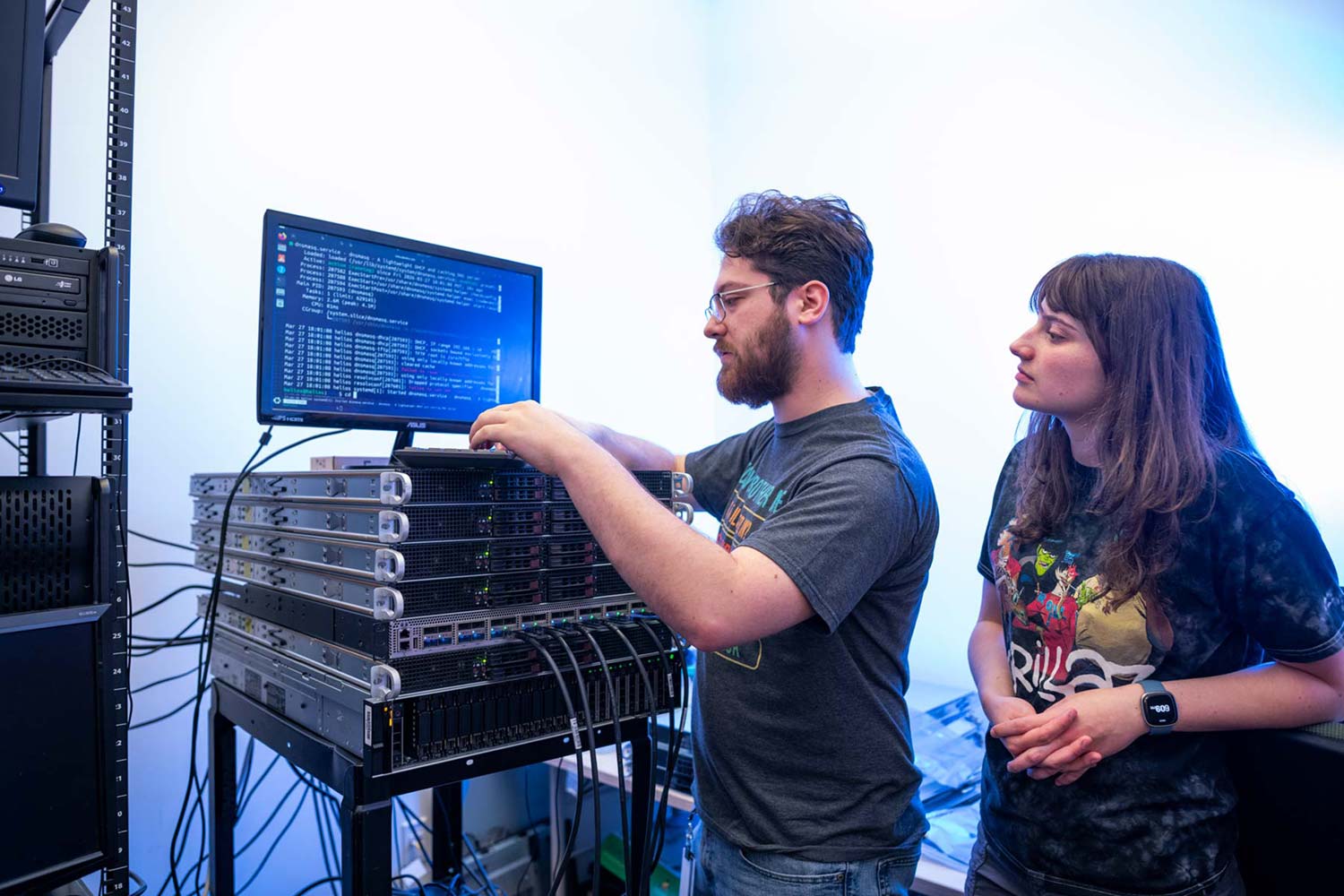
Tucked in a small, cool room in the Behavioral & Social Sciences Building, two supercomputers are helping Cal Poly Humboldt students and faculty explore some of the universe's biggest mysteries.

One, named Fusion, is used to simulate nuclear fusion, the process that powers the sun and stars. The other, named Helios, is designed to model something far more elusive—dark matter.

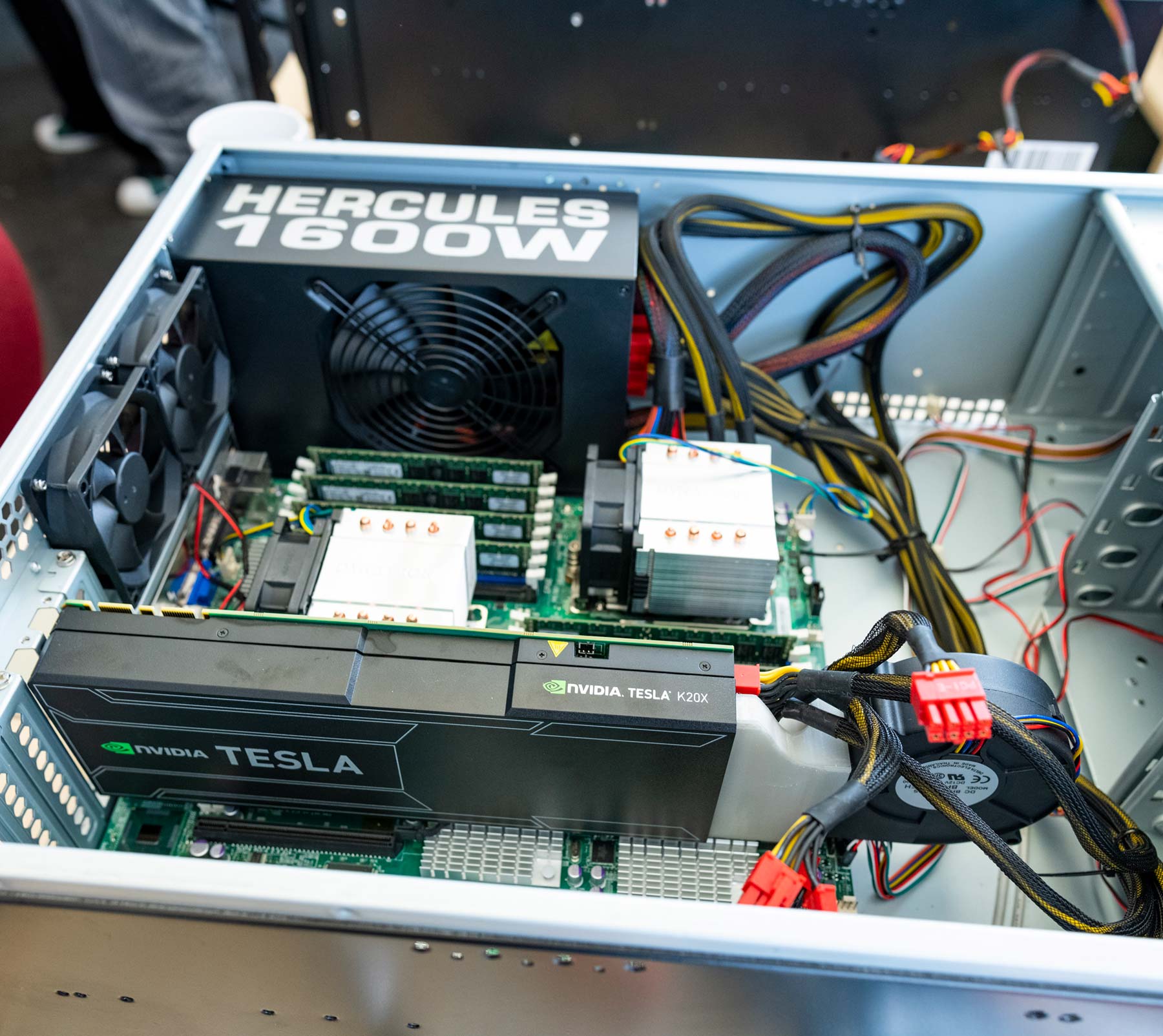
Dark matter is thought to make up most of the universe. It doesn't emit or reflect light, so scientists can't observe it directly. But they know it exists because of its gravitational effects on galaxies. So, they use simulations to try to understand it. That requires massive computational power, the kind typically found at major research institutions. But at Cal Poly Humboldt, a group of undergraduate students and faculty have assembled the machines piece by piece using materials sourced from places like eBay and powered by open-source software.

By doing so, they are contributing to research tied to one of the universe's biggest mysteries.

The group of students come from across disciplines—biology, math, computer science, and philosophy—to help understand one of physics' biggest unanswered questions: what is dark matter, and how it has shaped the universe.

The project has an ambitious goal: to simulate how dark matter is distributed throughout the universe and how it shapes the formation and movement of galaxies. To begin testing those ideas, the team created a simulation of the Milky Way using Helios, explains Ken Owens, Mathematics & Data Science professor and advisor on the project.

That simulated galaxy allows the researchers to test how different models of dark matter affect its structure and motion. By comparing simulated rotation curves—how fast stars orbit at different distances from the galaxy's center—to real observations of the Milky Way, they can see which models best match what is observed in space.

"That process requires tracking billions of interacting particles," Owens says. "To have students contributing directly to that process is remarkable."
Students and faculty work with computer equipment in a campus lab.
"Solving the challenges brought on by the scales of particles we are looking at, with some unique and novel techniques, will help others follow suit in their own projects about the universe—and maybe help solve some of its biggest mysteries."
-- Andrew Gallimore, Computer Science major

For Owens, astrophysics has always inspired a sense of awe.

"The universe is always expanding," he says. "I don't know if that keeps you up at night, but it does for me."

When he was a student, Owens worked in the lab of George Smoot, winner of a Nobel Prize in Physics for his work providing evidence supporting the Big Bang Theory.

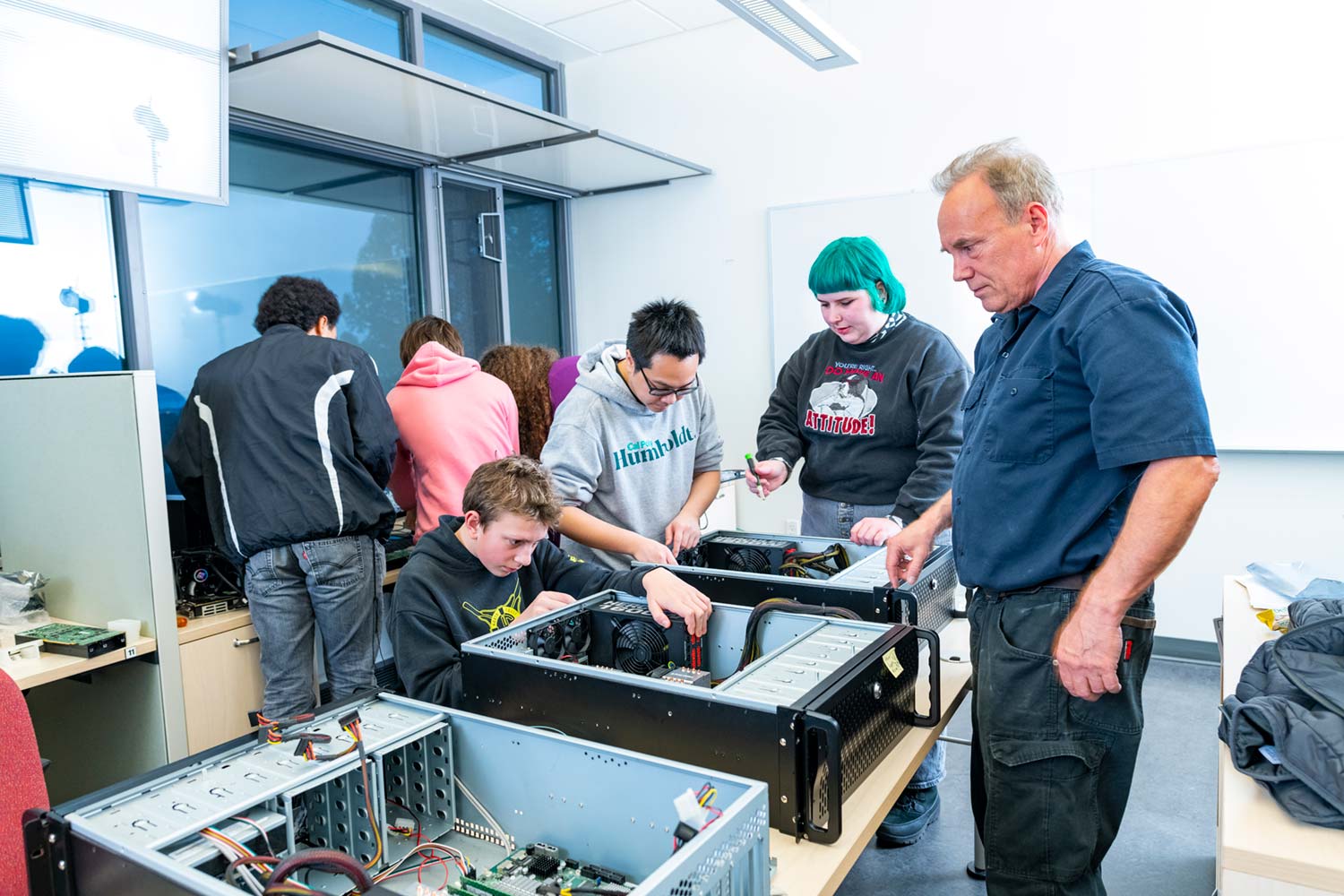
Now, Owens creates research experience for his students, spending every Friday night working together on the supercomputer—an opportunity he describes as very atypical at the undergraduate level.

Students and faculty work with computer equipment in a campus lab.
Professor Ken Owens (RIGHT) works alongside students from a variety of disciplines to build the supercomputers from the ground up.

Computer Science student Andrew Gallimore was drawn to the technical challenge of building a supercomputer and the opportunity to work collaboratively.

"I was looking for a more research-style environment, and this was it. It was a place where everything was very exploratory and uncharted, where we students were part of the expedition."

Gallimore has worked on both Fusion and Helios, writing scripts, configuring software, and refining simulations. He is currently writing a paper with Owens documenting the process of building the supercomputers as a roadmap for others interested in creating similar systems.

Students and faculty work with computer equipment in a campus lab.
Computer Science student Andrew Gallimore (LEFT) demonstrates Helios, the supercomputer built by students and faculty to simulate dark matter and explore how it shapes galaxies.

The experience has also opened doors beyond campus. This summer, Gallimore interned with the SETI Institute—a nonprofit organization dedicated to understanding the origin of the universe—where he helped develop software to detect exploding asteroids in the Earth's atmosphere using a supercomputer at NASA Ames Research Center. He says the skills he gained building and programming Humboldt's supercomputers prepared him to contribute to such large-scale research.

For Gallimore, one of the most rewarding aspects of working on Helios and Fusion has been the chance to collaborate with students and faculty from different disciplines.

"I learn a lot in my Computer Science classes, but this is a place where I can bring the skills I learned and contribute those with the physics and math skills others bring to make cool simulations and code, which I alone couldn't have," he adds. "Because of its interdisciplinary nature, it's giving me a solid taste of research and how projects work."

Gallimore often thinks about the project's potential to contribute to future discoveries about the universe. "The team has already made serious strides", says Gallimore. "We have exponentially reduced the amount of work needed to simulate nuclear fusion in plasma.

"Solving the challenges brought on by the scales of particles we are looking at, with some unique and novel techniques, will help others follow suit in their own projects about the universe—and maybe help solve some of its biggest mysteries."