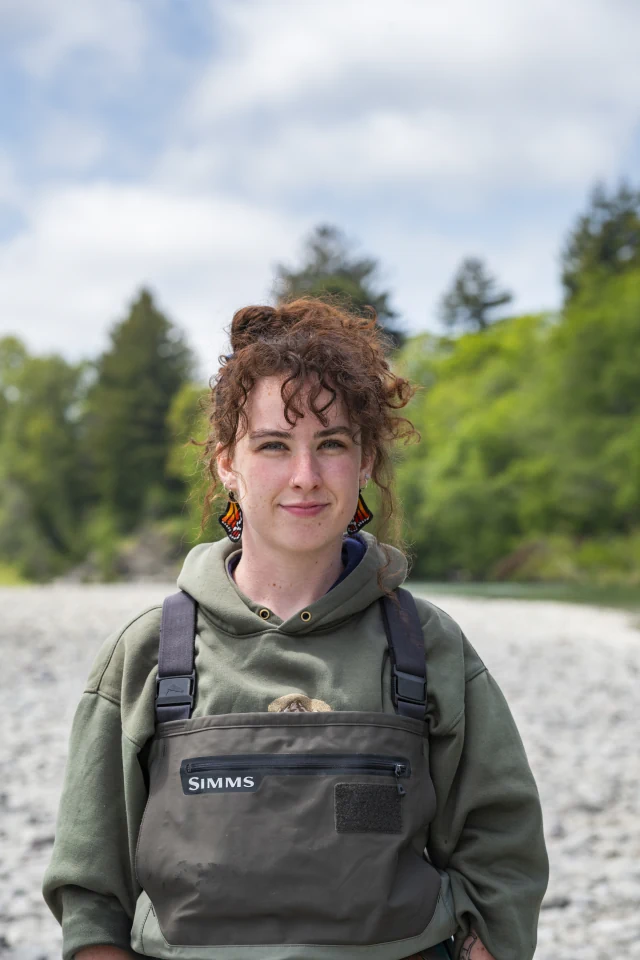
Finding Fisheries
“I was steelhead fishing with my dad on the Cowlitz River in Washington, and when we got back to the truck, there was a pamphlet on it about hatchery fish. I didn’t really know what it was talking about, but I wanted to understand why people were so angry about it.
On the 12-hour drive home, I started looking things up. I was trying to read peer-reviewed articles, even though I had no idea what was going on. But I started learning that fisheries science was a real field and that there were biologists studying questions about hatchery fish, wild fish, and how they affect each other.
I realized Humboldt had a Fisheries Biology program, with a freshwater concentration. I have always been interested in why fish do what they do—why they are there, why they come back up rivers, how their bodies work. Once I realized fisheries science was a real thing, it seemed really clear I could study this.”

A Reverence for Rivers
“I feel a lot of peace when I’m near water. One experience that stayed with me happened when I was steelhead fishing on a remote stretch of the Eel River. I was holding this hen steelhead, and I had this moment of realizing how old these fish are and how much bigger their life history is than mine.
She was in this canyon, and I was looking at her spots and fins and thinking about how everything is connected. There wasn’t a clear line where I started and where that fish ended. It was this feeling of interconnectedness.
I think fish have a kind of majesty. I can’t always explain it, but I have a lot of love for them. With climate change, it feels really important that we don’t just let these populations disappear. I know some of that is out of my hands, but if I can help protect a few streams or tributaries for future generations, I want to do that.”

First-Generation, Not the Last
“Being first-generation has meant recognizing the things that other people just kind of know that I don’t know, or the things they can ask their parents about that maybe I can’t. My parents are incredible in other ways, but college has its own language.
EOP has been really helpful because it’s a community of people who are also first-generation. You don’t feel quite as alone. I’m going to be the first person with my last name to graduate from a four-year university, which is crazy to think about.”
Mentoring Others
“My RAMP mentor in my first year was also in EOP and a natural resources student. I met with her a few weeks into my freshman year, and I remember feeling like, ‘This person gets it.’ She helped me understand where things were on campus, how to find resources, and how to navigate things I didn’t know yet.
That made me want to become a RAMP mentor.
With my first-generation mentees, I like to hold space for them and say, ‘Good job. The fact that you’re here is enough.’ You don’t have to get everything right all the time. You’re probably going to fail sometimes, and that’s part of it.
It’s easy to feel imposter syndrome, especially when you’re first-generation. I want my mentees to know that what they’re going through is normal, and also that it is extraordinary that they are here.
One of the most rewarding parts has been watching students find their agency. It’s incredible what people can do when they feel validated.”
Fire, Fieldwork, and Resilience
“I started firefighting when I was 18, right before I came to Humboldt. I work as a contractor volunteer firefighter with the U.S. Forest Service out of Kettenpom, where I grew up.
The funny part is that I don’t really like firefighting. I’m sensitive, and fire can be loud and scary. But California is so fire-prone, and it’s getting worse. During the 2020 August Complex Fire, my mom and I were evacuated for about nine weeks total, and the fire got really close to our house. That experience made me want to understand how fire works.
I’ve learned about fire behavior, weather, safety, and prescribed burning since becoming a firefighter. I was part of a five-day prescribed fire class, and putting good fire on the ground was an incredible experience. It made fire feel less like a monster and more like something with a scientific basis.
Firefighting has also helped me build skills for work in natural resources. Many field jobs ask whether you can be uncomfortable and still keep going. Fire has taught me that I can do hard things, even when I’m scared.”
Looking Ahead
“This summer, I’ll be working as a field intern with the Mattole Restoration Council, an organization focused on watershed restoration. I’ll be doing things like fuel reduction, invasive plant removal, and possibly redd surveys.
I’m excited because I haven’t had much hands-on experience in my major yet, and this feels like a real step toward that work. I’m also excited because the Mattole Restoration Council takes a holistic approach. They work with different agencies, incorporate Indigenous voices, and don’t just focus on one part of restoration.
At Humboldt, I feel like I can go in any direction. I could go into the workforce, pursue a master’s degree, or work toward a Ph.D. The field component of the fisheries program is really valuable. You’re not just in a classroom or a lab—you’re going out and doing these things.
By the time I graduate, I’ll be prepared for whatever direction I choose. I feel empowered by that.”
