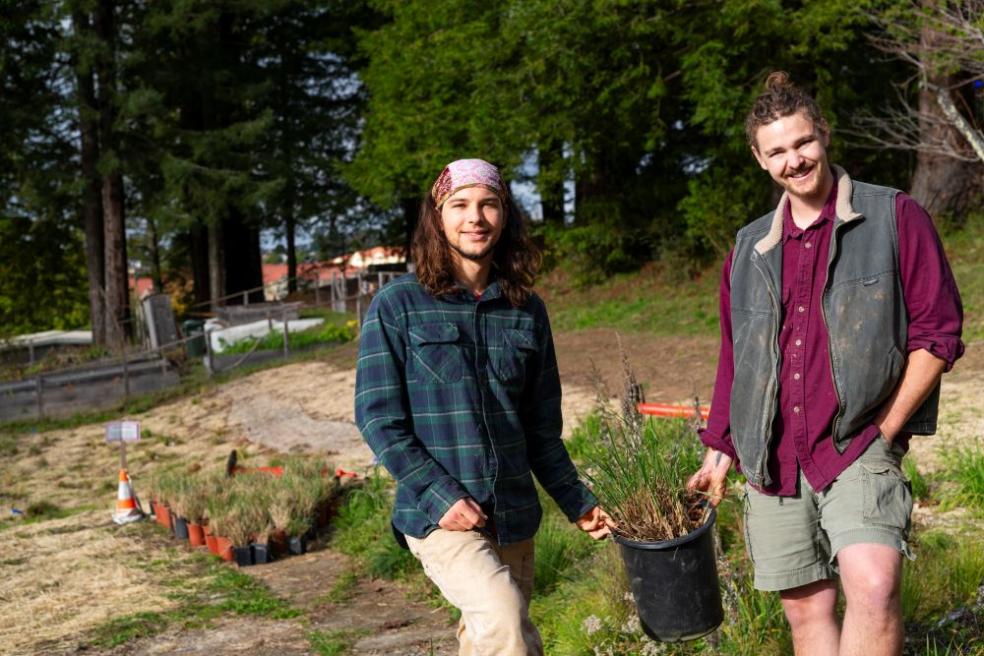
The idea for the pocket prairie began, as many Humboldt projects do, with a walk and a spark of curiosity. One spring afternoon, Rangeland Resource Science major Carter Daniel was heading past the theater buildings when a burst of pink and white blooms caught his eye. Rhododendrons and magnolias were blazing with color against a backdrop of uniform turf.
“It started with wanting more beauty in the landscape,” Daniel says.
But discovery led to a bigger question: What if that beauty wasn’t just ornamental? What if it were native—and could teach?
As Daniel moved deeper into his major, he became increasingly interested in grasses and forbs native to coastal Northern California, plants with deep ecological, cultural, and evolutionary roots. When the Cal Poly Humboldt Sustainable Humboldt Innovative Futures Trust (SHIFT) grant applications opened, the idea became clear: convert an ordinary campus lawn into a small native grassland, a “pocket prairie,” that could support wildlife and hands-on learning.
Around the same time, Environmental Science & Management major Jack McCann was pursuing his own path into native plant work. Motivated by the climate crisis and a desire to make a tangible difference, McCann spent years growing native plants and volunteering at a nursery in the Bay Area. At a campus volunteer event, he and Daniel struck up a conversation about what a truly educational landscape could look like.
California coastal prairies are among the most diverse grasslands in North America. In a small area, dozens of plant species can coexist, including grasses, sedges, wildflowers, and culturally important plants that have fed and supported local Indigenous communities for generations.

“We have an awesome opportunity here on the coast of California to bring back this really important ecosystem,” McCann says. “To me, it reflects the strength of diversity and resilience, and the interconnectedness of habitat.”
Together with Paul Stiles (‘24, Rangeland Resource Science), now a local environmental consultant, the team began shaping the vision into reality. They drafted the SHIFT proposal, worked through permitting and logistics, and met with Facilities Management to explore where this living laboratory could grow.
There were multiple options, but one location stood out: the sunny, open slope where the Jensen House once stood, just uphill from the Campus Center for Appropriate Technology (CCAT) garden, Wiyot Plaza, and other spaces.
“It was the right size in a great sunny location, and already had irrigation to help the plants get established,” says Liz Whitchurch, director of Facilities Operations. “There wasn’t anything else planned in the immediate future for that area. It seemed like the perfect place to try this type of planting on campus.”
Facilities made a deliberate choice to support the students while allowing them to lead.
“The idea came from students,” Whitchurch says. “We wanted to help where we could, but really let them take the lead on converting what used to be a house site—and then a lawn—into something with educational and aesthetic value for the campus.”
Facilities is watching the project closely as a template for possible future large, native landscaping efforts. They’ve committed to ongoing maintenance, annual high mowing, and targeted weeding.
“This gives us something you can point to and say, ‘This was dreamed up by a student group, implemented by a student group, and it aligns with our sustainability goals,’” Whitchurch says. “If it thrives here, it creates opportunities to do more of this kind of planting.”
Under the guidance of Rangeland Resource Science Professor Justin Luong, who specializes in rangeland restoration, the team got to work. Stiles created a professional planting design and species list. Students grew many plants in the campus greenhouse and sourced others from native nurseries.
When planting day arrived, the community showed up in force. Dozens of students and volunteers knelt across the hillside, tucking hundreds of young native plants into the soil.
For Luong, the pocket prairie enhances Humboldt’s outdoor learning spaces on campus.
“It’s really difficult to get to high-quality grasslands from campus,” Luong says. “Most nearby areas are forested, or they’re private pastures. A true coastal prairie, with this level of biodiversity, is extremely hard for students to access.”
Now, just a few minutes’ walk from classrooms, students have a compact but ecologically rich site to study. More than 30 native species were planted: deep-rooted bunchgrasses that store carbon and conserve water, flowering forbs that support pollinators, and culturally significant species tied to Indigenous traditions and stewardship.
The impact on academics could be wide-reaching. Courses in restoration, ecology, soils, botany, and environmental education can use the prairie to practice monitoring techniques, build long-term datasets, and examine how ecosystems respond to disturbance and change. Clubs like Range & Soils, Natural Resources, and the Greenhouse Club could continue working in the space.
“It becomes a place where students can keep asking questions,” Luong says. “About restoration, about grasslands, about soil, about pollinators. They don’t have to wait for a big field trip; they can walk up the hill.”
For Daniel, the prairie is also a model for what campus landscapes can become.
“Native plants have a long evolutionary history with local insects. They provide so much more food and habitat. I hope someday this isn’t ‘the Pocket Prairie project’—it’s just one of many native landscapes on campus. The long-term vision is to normalize this kind of landscape because it’s what belongs here.”