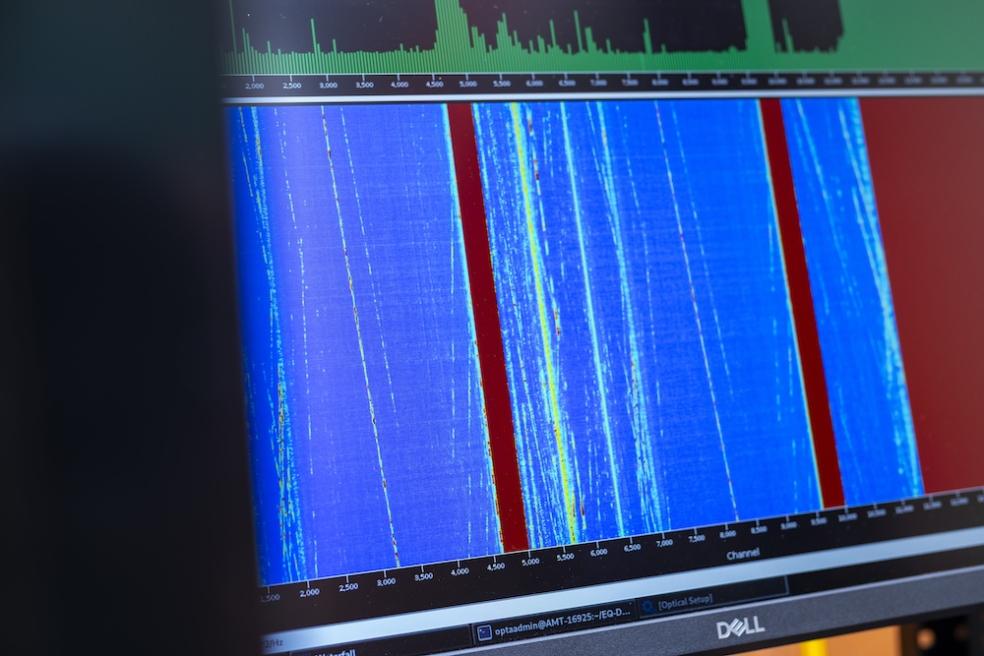
In a new study published in Nature Communications, researchers from the U.S. Geological Survey (USGS) and Cal Poly Humboldt used signals picked up by fiber-optic cables—the same ones that deliver high-speed internet—to accurately estimate when a moderate to large earthquake is underway with data from the first four seconds of the seismic wave arrivals.
The technology could strengthen earthquake early warning systems. By sending alerts to apps, phones, and emergency managers, these systems can give people more time to take cover or take preventative actions like slowing trains and shutting off gas lines.
"One of the biggest challenges in earthquake early warning is determining how large an earthquake has become as quickly as possible," says USGS geophysicist and study coauthor Theresa Sawi. “This study shows that fiber-optic sensing may help answer that question within seconds.”
The more accurate the estimate, the better we can characterize which earthquakes warrant alerts, said Sawi.
Much like the first rumble of thunder can reveal whether a storm is approaching, the earliest moments of an earthquake contain clues about what may follow. The clues are in the vibrations produced at the beginning of an earthquake.
Smaller earthquakes and larger earthquakes generate different patterns of seismic energy, creating distinct “signatures.” For example, seismic waves from larger earthquakes may be predominantly lower-frequency vibrations. The researchers trained a machine-learning system to recognize those differences with surprising accuracy.
They used data from real earthquakes ranging from magnitude 3.5 to 7.1 detected from sensors that use the same measurements of ground movement as fiber optic cables located across California. They applied the results to data from a fiber optic cable in Arcata and Eureka in Northern California—a region located in the most seismically active part of the continental United States. The fiber optic cable is maintained by researchers from Cal Poly Humboldt and the USGS as part of a collaborative study focused on a technique called distributed acoustic sensing. The technique allows scientists to use existing fiber optic cables as earthquake detectors. When seismic waves move through the ground, they alter how light travels through the cable. Scientists can measure those changes and use them to detect vibrations from an earthquake.
Traditional earthquake monitoring relies on instruments installed at individual locations. But fiber optic sensing transforms existing telecommunications cables into a dense network of sensors. Because these cables already crisscross the seafloor, the technology could expand earthquake monitoring in offshore areas where conventional sensors are difficult and expensive to install. Faster estimates of earthquake size could give coastal communities more time to prepare for both strong shaking and potential tsunamis.
For Connie Stewart, study coauthor and executive director of University Initiatives at Cal Poly Humboldt, the study also highlights the value of investing in public infrastructure.
"Expanding broadband infrastructure creates opportunities far beyond internet access—especially for rural communities on the North Coast," Stewart said. "This study demonstrates how investments in fiber optic networks can also advance scientific discovery and, ultimately, help build safer, more resilient communities."