At Cal Poly Humboldt, Olivia Chase is helping carry that tradition forward.
When Chase transferred to campus, she envisioned a space where Indigenous students could gather to nurture their relationship with fire in both its cultural and ecological contexts. In January 2024, she turned that vision into reality by founding the Cultural Fire Club—one of the first student organizations of its kind within the California State University system.
Chase, a senior Environmental Science & Management major and member of the Tsnungwe Tribe, founded the Native student-led club to create an inclusive space for Indigenous students to engage in cultural burning, support Tribal efforts, and connect Indigenous and Western approaches to fire science.
Cultural burning takes many forms, she explains. It’s prescribed burning. It’s prevention work. It’s cooking. It’s tending the plants that communities rely on.
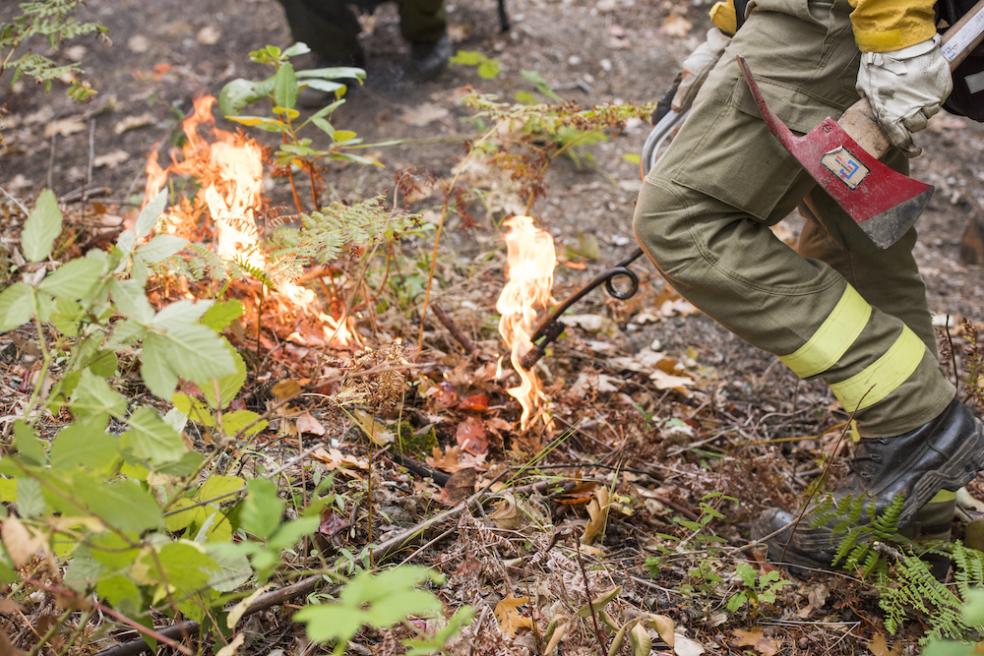
Last fall, club members participated in a prescribed burn with the Blue Lake Rancheria, working under tan oak trees to support acorn production, a traditional food source for several Tribal communities.
“If you don't burn the underbrush, pests nest there, and then infest the acorns,” Chase says.
Beyond prescribed burns, club members participate in fire safety training and plant identification workshops, and partner with a private landowner to conduct pile burns and thin encroaching conifers. Without regular burning, conifers have overtaken oak woodlands, shading out trees vital for acorn production, Chase explains. By restoring light and reducing fire risk, students help return the landscape to a healthier balance.
Chase is quick to correct a common misconception that cultural burning is solely about managing wildfire risk.
“There are so many purposes for burning. We just live in an ecosystem where everything is designed to burn every few years,” she says. “Cultural fire is not just a management tool, it’s who we are.”
Fire, she added, is central to ceremony, food systems, and daily life.
Basketry, too, depends on fire. Chase has participated in cultural burns for basketry materials as well as to remove brush that interferes with acorn production.
Chase first learned about cultural burning during the COVID-19 pandemic.
“We had a really bad fire year, and I was worried. I was worried about my community and my people, and I didn't know how we were gonna fix this problem,” she says. “But then I started learning about cultural burning and learning about how—especially women in our Tribes—play a role in protecting our communities. It inspired me and made me want to go to school.”
Since starting the club two years ago, Chase says she gained new skills and has connected more with the community.
“People think of us now, they want us to come be involved, and so that's been really special. I've also learned how to organize people and organize events, and it's given me a lot of confidence in my ability to make things happen,” she adds. “I have more confidence in myself.”
In the near future, she hopes to work with the Rou Dalagurr Food Sovereignty Lab & Traditional Ecological Knowledges Institute and is planning workshops to provide firewood for Tribal elders in the community.
For Chase, cultural burning is not only about restoring ecosystems. It’s about restoring relationships—to land, to knowledge, and to community.