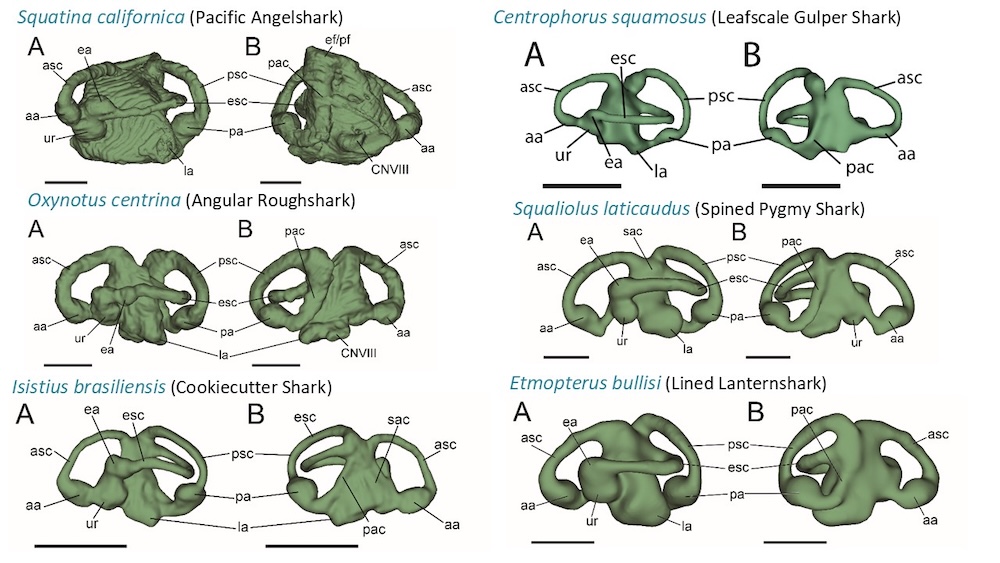
The study, recently published in The Anatomical Record, examined the ears of 10 species of sharks, revealing surprising differences in the shape and structure of an organ that helps them hear and maintain balance.
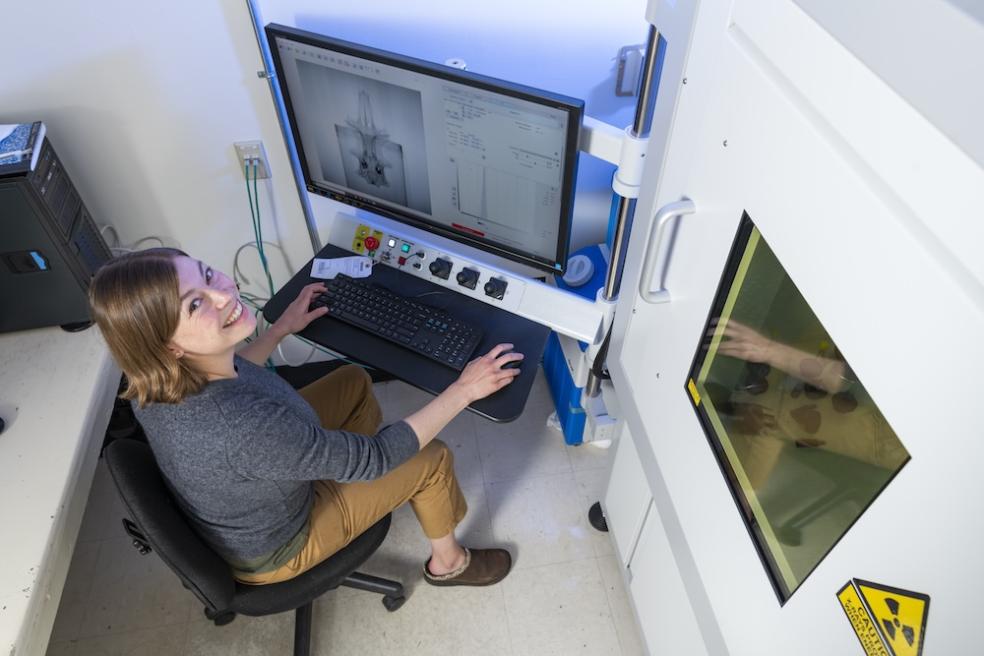
The research team, led by Cal Poly Humboldt students Kaci Dodd and Isamar Lopez-Argueta, and Biological Sciences Professor Allison Bronson, used CT scanning to digitally dissect the heads of 10 species of sharks and examine their inner-ear structures in three dimensions.
They studied a wide range of sharks with different habitats, including: tiny bioluminescent lantern sharks and deep sea gulper sharks, the ancient-looking frilled shark, flat ambush predators like the angel shark, and six- and seven-gill sharks.
The researchers expected the inner ears to be shaped by the sharks’ ecology, including diet and habitat, similar to what’s been found in other groups of vertebrates, Bronson explains. For example, they wondered whether differences in ear shape might be related to the need to hear certain types of prey or adapt to life at great depths.
Instead, they found that sharks with similar diets and habitats actually had very different ear shapes, so it could be that ear structures are more strongly influenced by evolutionary history. In other words, sharks who are more closely related have similar inner-ears, even when they live in different environments.
“The findings are significant because it gives us a new way to understand shark evolution and further explore how their sensory system evolved,” says Bronson. “This work was possible because we could combine CT technology and a global network of natural history collections.”
The work required researchers to pore over grayscale CT images for hours, a process Bronson likens to a digital coloring book for adults.
Thanks to publicly available specimen data, the Cal Poly Humboldt Fish Collection Database, and collaboration with museums around the world, Bronson’s team has been systematically documenting the inner ear anatomy of every living group of sharks and rays. The lab began this work six years ago, and 15 undergraduates have participated in the project to date. The work is now supported by a grant from the National Science Foundation. To explore an updated collection of ear models, go to website Sketchfab.com.