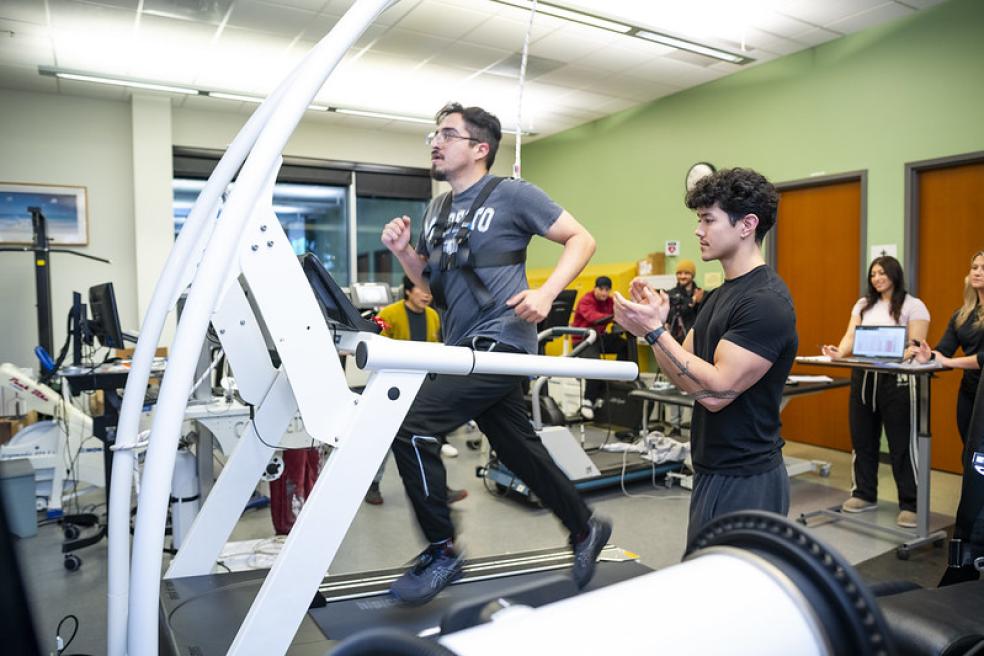
Known as Advanced Footwear Technology (AFT) shoes, these high-performance running shoes feature resilient foam, thick midsoles, and embedded carbon-fiber plates designed to improve economy for runners. Studies show they can reduce the energy cost of running by as much as 2.7–4.2%. But not all runners experience the same benefits.
That’s where Kinesiology major Diego Honda comes in.
Honda serves as the lead investigator on the project, with co-principal investigators, Interim Dean of the College of Professional Studies and Kinesiology Professor Justus Ortega, and New Balance Director of Sports Research, Jinger Gottschall. Together, the team is studying how different runners respond to AFT shoes by analyzing movement, force, and muscle activity.
“We’ve just been interested in seeing how different runners react,” Honda said. “Not everyone responds the same way.”
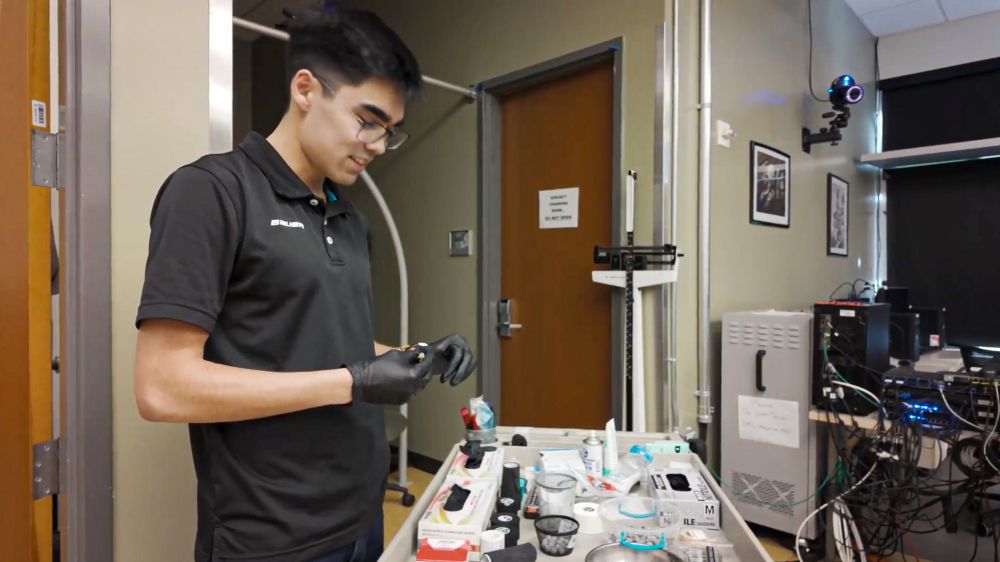
The study focuses on understanding how runners differ in their responses to AFT shoes and what may underlie those differences. The team uses advanced tools like 3D motion capture, electromyography (EMG), and metabolic analysis to study movement and muscle activity to measure details such as how people walk and how their muscles activate.
“Digital motion capture is similar to what you see in behind-the-scenes Hollywood films,” Honda explained. “We can recreate their bodies in 3D software so we can analyze their running form.”
For Honda, the project is the culmination of a growing interest in biomechanics that began during the COVID-19 pandemic. “I started reading a lot about it,” he said, citing the book “Born to Run” as an early influence. “Then, when I came here, I met with Justus Ortega for the first time, and he guided me to explore more options in this field.”
That curiosity led Honda to take initiative. He drafted a research proposal and, with Ortega’s support, reached out to industry partners. New Balance said yes.
“It was definitely a little unexpected,” Honda says. “But it is very cool being able to work with such a big and prominent athletic company, especially just as an undergrad student.”
The collaboration has been hands-on from the start. A New Balance biomechanist visited campus to help refine data-collection methods, and Honda continues to communicate regularly with the company as the study progresses.
“We collaborated in creating the overall goal of the project and the methods,” Honda says. “Then we’ve been entrusted with the data collection.”
Honda also leads a team of student researchers, coordinating schedules, managing participants, and troubleshooting challenges along the way.
“It’s been a lot of organization, a lot of leadership, a lot of communication,” Honda says. “And in research, a lot can go wrong—so it’s about finding the best way to manage that.”
The project has already enrolled about 30 participants, with a goal of reaching 40. While results are still being analyzed, the implications could extend beyond elite racing, influencing how everyday runners choose their shoes.
Equally important is the experience itself.
“The ability to get hands-on experience and collaborate in this sort of research has really helped me become more interested in the field,” Honda says. “It’s not an opportunity many students at other universities get.”
After graduating this spring, Honda plans to continue the research while applying to a master’s program in sports science in Japan.
He hopes the project will open doors for future students as well.
“If this goes well, it provides further opportunity to future generations of students,” Honda says.