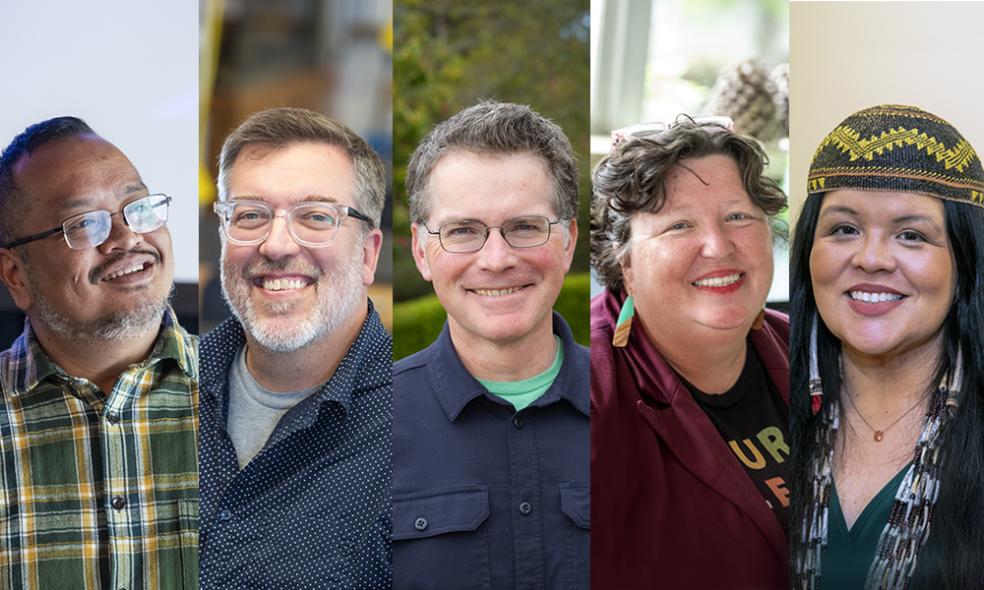
Since 1964, Cal Poly Humboldt has celebrated exceptional faculty through the Distinguished Faculty Awards—a competitive, peer-nominated process. Nominations are reviewed by the University Senate’s Faculty Awards Committee, which recommends recipients to the Senate. Final approval and conferral of the awards are made by the university’s President.
Paul Michael Leonardo Atienza, Outstanding Service Award
Paul Michael Leonardo Atienza, assistant professor of Critical Race, Gender & Sexuality Studies, has a distinguished record of institutional and community service and leadership in shared governance and program development.
He has played a key role on the Integrated Curriculum Committee’s GEAR subcommittee, where he reviewed complex course proposals, contributed to policy and assessment discussions, and supported faculty across disciplines in navigating general education requirements. This led to co-designing the new Digital Humanities Certificate of Study that begins in Fall 2026. He also created two courses in Asian American Studies and two additional courses in science and technology studies, enhancing campus curricular diversity.
As a key faculty co-organizer and facilitator for the Campus & Community Dialogue on Race, he coordinates speakers, panels, screenings, and public discussions that bring nationally recognized scholars, artists, and activists to Humboldt. Atienza also coordinates an annual World AIDS Day commemoration and public scholarship events.
He is currently the faculty advising fellow for the Asian, Desi, Pacific Islander, Middle East & North African (ADPI+MENA) Center. The advising fellow provides support to all students through the ADPI+MENA Scholar Program. He has also served as faculty representative during the design, testing, and implementation of the new Advising Hub platform.
He serves on the steering committee for Humboldt Asians & Pacific Islanders in Solidarity (HAPI), securing grant funding and building partnerships between the University and local community groups. He has expanded cultural programming and created opportunities for students to connect academic learning with community engagement.
Atienza does more than participate in service activities; he builds, sustains, and strengthens programs that shape the University's institutional life. His work consistently reflects initiative, reliability, and a deep commitment to student-centered service.
Paul E. Bourdeau, Scholar of the Year Award
Marine Biology Professor Paul E. Bourdeau is a highly respected researcher whose work has made significant contributions to ecology and marine science. His research focuses on predator-prey interactions and ecological processes under the stress of climate change and ocean acidification.
Over more than two decades, he has advanced our understanding of predator–prey interactions and ecological processes. His scholarship integrates laboratory experimentation, field-based ecology, quantitative modeling, and meta-analysis. He has authored more than 35 peer-reviewed publications in journals, with his work cited more than 1,200 times.
Deeply rooted in the North Coast, much of his work is place-based, grounded in near-shore marine ecosystems and connected to applied questions of climate resilience, invasive species management, and habitat restoration. His scholarship includes collaborative work on a $1.11 million grant focused on improving climate resilience for Northern California tribal fisheries.
A defining feature of Bourdeau’s scholarship is the integration of students into high-impact research. Since 2014, he has mentored 17 graduate students, many of whom have published their thesis work as first authors in professional journals.
His laboratory at the Telonicher Marine Laboratory is one of the University’s most productive research environments. Bourdeau’s work advances fundamental ecological theory while addressing urgent environmental challenges like invasive species management and habitat restoration.
Brandon L. Browne, Excellence in Teaching Award – Tenure Line
Geology Professor Brandon L. Browne is guided by a clearly articulated philosophy centered on connection, active engagement, and carefully aligned course design. His courses integrate learning objectives, instructional activities, and assessments. His syllabi, practice exams, scaffolded assignments, and multi-draft writing processes reflect thoughtful alignment and transparency.
A hallmark of his instruction is a commitment to high-impact, experiential learning, with every course including substantial field-based components. These immersive experiences allow students to apply theoretical knowledge to real-world contexts, develop professional field skills, and cultivate collaborative problem-solving abilities.
Deeply committed to cultivating the next generation of geoscientists, he is a dedicated research mentor who has supervised numerous undergraduate and graduate theses, preparing future geoscientists for professional success.
Browne has contributed substantially to departmental and institutional teaching culture. He has strengthened instructional coherence across the program while maintaining an active and rigorous teaching portfolio. Even with more than 20 years of teaching experience, he continues to revise course materials, author original instructional resources, and incorporate student feedback to refine assessment practices and improve learning outcomes.
AmyK Conley, Excellence in Teaching Award – Lecturer
AmyK Conley—program leader of and instructor for the Liberal Studies Elementary Education—embodies the highest standards of teaching excellence through her innovation in grading and assessment practices and leadership in teacher preparation; and for her impact on institutional teaching culture and K–12 education in our region.
Conley operates on the principle that “everyone deserves literacy,” integrating multisensory practices and dyslexia screening frameworks, structured vocabulary instruction, and performance-based assessments into her curriculum.
An exceptional educator, she redesigns her courses based on student feedback around a growth-based grading model. This approach shifts the focus from point accumulation to mastery, which shifts emphasis from grade anxiety to professional readiness. Through this work, she has fostered faculty dialogue about equity, motivation, and student-centered evaluation practices across disciplines. Her scholarship integrates research and pedagogy, exemplifying a lecturer who advances teaching not only through practice, but also through inquiry and dissemination.
Conley supports credential candidates through high-stakes performance assessments. She has contributed meaningfully to Cal Poly Humboldt’s broader teaching culture. Conley’s influence extends into regional K-12 schools, where the educators she teaches serve as literacy mentors in local schools, strengthening the connection between academic preparation and community needs.
Cutcha Risling Baldy, Outstanding Professor
Cutcha Risling Baldy is Hupa, Karuk, and Yurok and is enrolled in the Hoopa Valley Tribe. An associate professor of Native American Studies, she is a transformational leader who has created programs, strengthened institutional capacity, and influenced statewide policy and community practice.
Her work integrates teaching, scholarship, and service, notably through her role as co-founder and co-director of the Rou Dalagurr: Food Sovereignty Lab & Traditional Ecological Knowledges Institute. She developed a nationally distinctive model of experiential, place-based, and Indigenous-centered learning. Through this work, students engage in hands-on research, community collaboration, grant-funded projects, public scholarship, and applied curriculum development. Dozens of students have found paid work through the lab, gaining professional experience and building pathways into graduate study and community leadership.
A nationally and internationally recognized scholar, she is the author of We Are Dancing for You: Native Feminisms and the Revitalization of Women’s Coming-of-Age Ceremonies, which won the Best First Book Award from the Native American and Indigenous Studies Association.
She has secured approximately $2.8 million in external funding to support original research, graduate education, student employment, and sustained Tribal and community partnerships. She has also secured more than $1.8 million in funding to create sustained programming that serves students, faculty, Tribal communities, and regional partners. Her leadership was further recognized with the 2025 James Irvine Foundation Leadership Award for her work advancing Indigenous science, education, and community-based research.
Her research makes substantive contributions to policy and public scholarship, including authoring a chapter in reports for the California Department of Justice on Missing and Murdered Indigenous Peoples. Her service includes leadership on statewide curriculum development initiatives, including California’s Native American Studies model curriculum, as well as California State University committees and multiple Tribal and nonprofit boards.