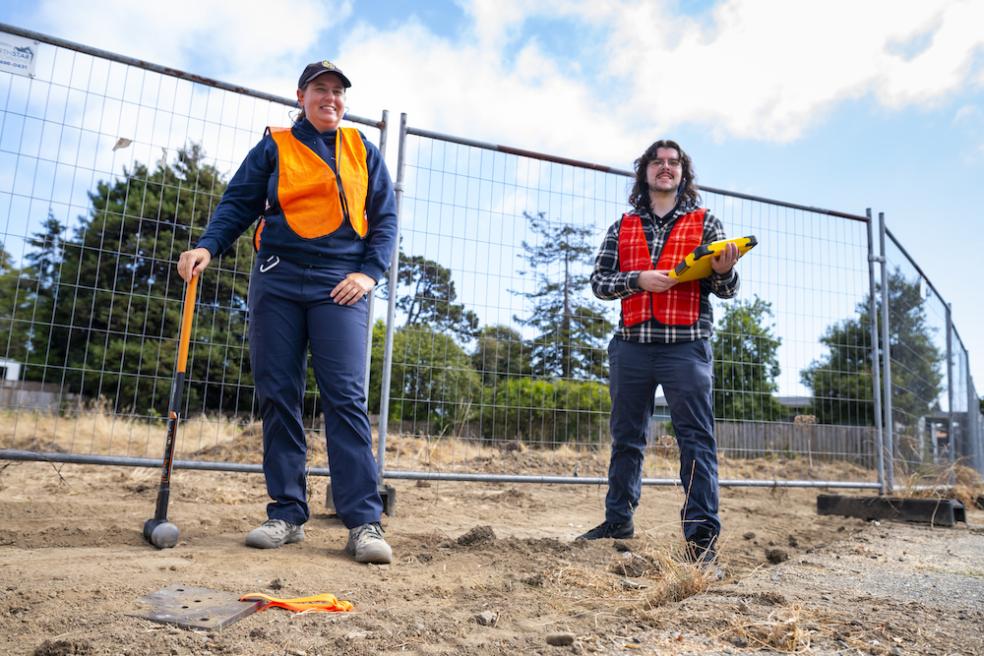
Each blow sends a clang echoing down the street and vibrations deep into the ground. In a lab half a mile away, scientists watch their screens to see whether those vibrations register on a seismometer-like machine—a Distributed Acoustic Sensing interrogator. The strikes are spaced five seconds apart so they’re distinguishable from other ground noises, like passing cars.
The students are running what’s known as a tap test—part of an experiment to explore using fiber optic lines to detect earthquakes, which could one day help communities more quickly receive warnings of seismic events.
This project is part of a multi-year, multi-agency effort led by the U.S. Geological Survey (USGS), Cal Poly Humboldt, Vero Fiber Network, and state and local partners to monitor seismic activity.
The tests take place above buried fiber optic cables in Humboldt County, which lies in the most seismically active part of the continental U.S. These cables, which will provide high-speed internet to more than 20,000 residents in the region, can also be used to detect earthquakes by capturing even the tiniest seismic disturbances. When vibrations—whether from a sledgehammer or a real earthquake—pass through, they slightly stretch or compress the fibers, changing the light pulses that carry data. Scientists can detect those changes on the interrogator, which is connected to the cables and is so sensitive, it can detect earthquakes as small as magnitude 1 on the Richter scale.
“This is a major leap in seismology research capability,” explains Eric Riggs, co-lead on the project and Dean of the College of Natural Resources and Sciences at Cal Poly Humboldt. “It’s ushering in a new era of earthquake detection and monitoring.”
Fiber optic earthquake detection systems help scientists understand how to better prepare for the impacts of earthquakes, explains USGS geophysicist and ShakeAlert Chief Scientist Jeff McGuire. “A system like this could also potentially be used for the quick earthquake detections needed to give hospitals, schools, and entire communities a few precious seconds to brace for impact and reduce damage.”
The research builds on work already underway in Humboldt County, where fiber optic cables are being installed to expand internet access as part of California’s Middle Mile broadband expansion program. Three years ago, Cal Poly Humboldt partnered with USGS on a pilot study using a small fiber line between Arcata and Eureka. Traditional seismometers were installed parallel to the fiber line to study the difference between what the methods detected during an earthquake.
The project has also strengthened Cal Poly Humboldt’s earthquake research capabilities and expanded its role in statewide seismic research. The University recently became a participating institution in the Statewide California Earthquake Center. The center is a collaboration between agencies throughout the state that work to advance earthquake science, community resilience, and education.
Over the next three years, researchers—including students—will continue to evaluate the cables’ ability to monitor seismic activity. Cal Poly Humboldt will act as a central hub, linking fiber optic lines and creating a testbed for the technology.
This technology is revolutionizing earthquake monitoring and research, says McGuire. “Cal Poly Humboldt is creating an amazing test facility for seismic research. By using the fiber optic networks already in place, we will collect the data needed to test ways to build a faster, smarter early warning system that can reduce the impact of future earthquakes.”