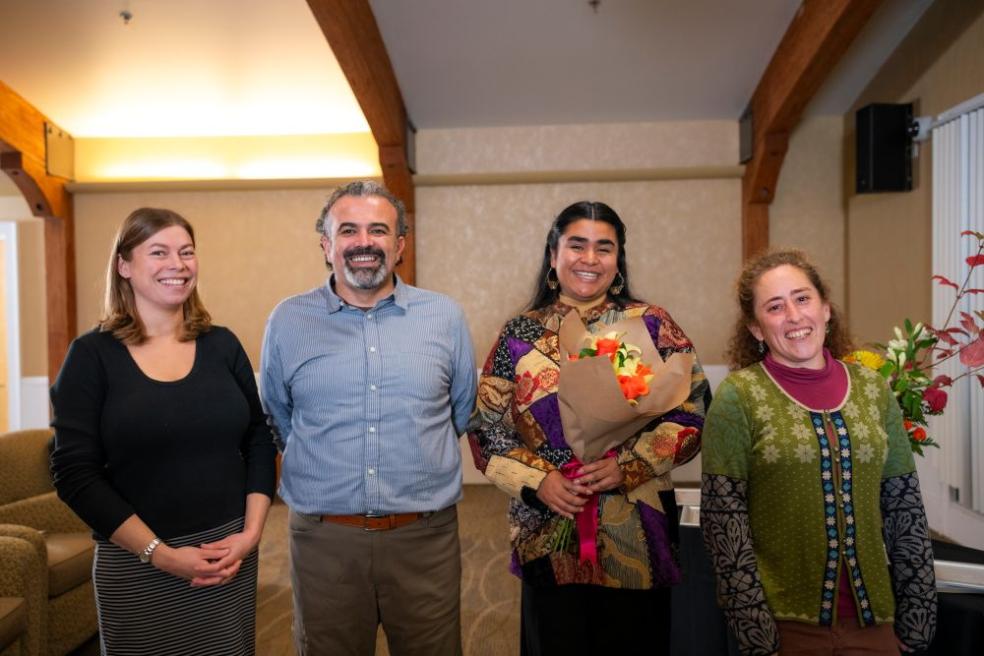
Congratulations to the 2025 President Alistair McCrone Promising Faculty Scholars Award winners:
- Allison Bronson, assistant professor of Biological Sciences
- Alana Chin, assistant professor of Biological Sciences
- Çağlar Dölek, assistant professor of Sociology
Additional congratulations to Yaneyry Delfin Martinez, graduate student in the Public Sociology program, for winning the Alistair & Judith McCrone Graduate Fellowship Award.
The following are brief biographies of the 2025 McCrone Promising Faculty Scholars and the Alistair & Judith McCrone Graduate Fellowship Award winner.
Allison Bronson
Allison Bronson (‘14, Biology, Zoology) is an assistant professor in Biological Sciences. Bronson’s passion for fishes began in childhood, inspired by her dad’s tropical fish tank and her grandma’s enthusiasm for learning. At eight, she decided to become an ichthyologist. While earning her undergraduate degree, Bronson also minored in Botany and Scientific Diving.
During her studies, she collaborated with faculty mentors on research involving snails, fungi, and newts. Moving to New York City, she obtained a Ph.D. in Comparative Biology from the American Museum of Natural History, focusing on shark fossils with advanced techniques like CT scanning. Bronson has published 18 peer-reviewed articles and often collaborates with Cal Poly Humboldt students. Her current research investigates the deep evolutionary history of sharks and the anatomy of North Coast fishes. Recently funded by a National Science Foundation award, her lab is exploring the relationship between the shape of sharks' inner ear structures and their habitats, contributing to our understanding of fish evolution over 500 million years.
Alana Chin
Alana Chin (‘05, Wildlife, ‘08, M.S. Biology) is an assistant professor in Biological Sciences. Chin grew up in Potter Valley and attended Mendocino College and the College of the Redwoods before transferring to Humboldt. It was during this time that she began her research into tall tree physiology. Chin holds a Ph.D. in Ecology from the University of California, Davis, and she joined Cal Poly Humboldt after serving as a research fellow at ETH Zürich.
Her current work focuses on how trees respond to abiotic factors and management practices, examining these interactions from the sub-micron level to overall plant function. Chin is involved in several projects, including research on heartwood development, seasonal growth dynamics, and carbohydrate storage in redwood trees. Additionally, she is writing a paper that explores the traits regulating water absorption in twigs to better understand the differences among species. Overall, her research at Humboldt addresses the impacts of climate change on trees and, conversely, how trees affect the climate. She aims to develop practical, mechanistically grounded tools for predicting tree function and survival in our changing world.
Çağlar Dölek
Çağlar Dölek is an assistant professor in Sociology, engaged in a transdisciplinary research agenda that encompasses critical criminology, urban sociology, political economy, and social history. His work investigates the formation of state power and its relationship with class formation, social marginalization, and political contestation. He earned his Ph.D. in Sociology with a specialization in Political Economy from Carleton University in 2019 and has an interdisciplinary background from Middle East Technical University.
Dölek has published extensively on topics such as the capitalist state and neoliberal authoritarianism, co-editing Turkey’s New State in the Making: Transformations in Legality, Economy, and Coercion. He is currently finalizing a manuscript titled Policing Slums in Turkey: Crime, Resistance, and the Republic on the Margin, which explores police power and urban marginality in Ankara.
As a dedicated educator, Dölek believes in the transformative power of higher education and employs active learning strategies to foster critical thinking and civic engagement with his students. He has initiated innovative teaching projects, including "Marginalized Poor and Radical Imagination," now part of the Sociology departmental curriculum, and plans to launch "Global Carceral Power and Popular Resistance" in Fall 2026.
Yaneyry Delfin Martinez
Yaneyry Delfin Martinez is a Public Sociology master’s student from Oceanside, California. Immigrating to the United States at age four profoundly shaped their understanding of society and motivated them to pursue higher education. They earned their B.A. in Chicanx Studies and Sociology from the University of California, Davis, where their research in a mental health program for undocumented students ignited their interest in participatory research.
Delfin Martinez’s experiences and research contributed to advocacy efforts that helped establish the Dreamer Center at Cal Poly Humboldt, enhancing support for undocumented students. They currently serve as the director of Scholars Without Borders, a student-led organization advocating for these students, and are part of the student legal team at the Coalition for Humane Immigrant Rights, assisting with Deferred Action for Childhood Arrivals renewals.
Their thesis focuses on liminality in higher education, marginalized student support systems, and the impact of immigration policy on college access. Delfin Martinez aims to pursue a Ph.D. in Sociology, conduct independent research on border politics and liminal spaces, and engage in policy work to advance pro-immigrant legislation, remaining dedicated to making higher education more accessible for immigrant communities.