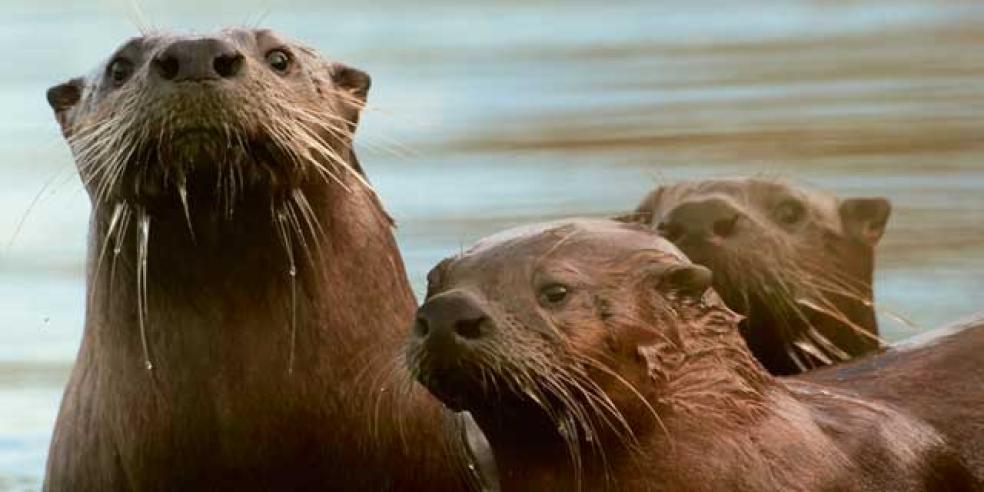
The North Coast Otters Public Arts Initiative combined public art, community engagement, and conservation education while directly funding graduate student research focused on river otters and the ecosystems they inhabit along California’s North Coast.
Launched in 2023, the initiative featured more than 100 hand-painted otter sculptures displayed throughout the North Coast before being auctioned to support research and raise awareness about river otters and wetland conservation.
The otter art project ultimately raised more than $300,000 to support student research, conservation, and public education efforts. The initiative highlighted the ecological importance of river otters while bringing together artists, businesses, Tribal members, and local residents to celebrate the region’s wetlands and wildlife.
“These projects demonstrate the incredible range of questions students can explore when they have strong community support behind them,” says Black. “The otter initiative created opportunities for students to contribute meaningful research while helping people better understand the ecosystems right here in Humboldt County and the North Coast.”
Among the funded projects was research by Gina Culver (‘19, Wildlife, ’25, M.S. Wildlife), who investigated how river otters prey on wintering waterbirds at the Arcata Marsh and Wildlife Sanctuary. Culver examined feathers recovered from river otter scat and compared them with museum specimens to identify which bird species otters consumed.
Her research found that river otters preyed on 15 species of waterbirds, most commonly bufflehead and ruddy ducks, two diving duck species that forage underwater. Culver’s work revealed that otters did not simply prey on birds based on abundance, but instead selected species whose anti-predator behaviors made them more vulnerable underwater.
Whitney Vickers (‘22, Wildlife, ’25 M.S., Wildlife) explored the social lives and kinship patterns of river otters across Humboldt County wetlands. Through behavioral observations and DNA analysis of scat collected from 10 locations between Trinidad Harbor and the Eel River estuary, Vickers identified 83 individual otters using the Humboldt Bay region.
Her work showed that otters regularly travel between wetlands and form dynamic social groups. She also found evidence that “helper” otters assisting with pup care were genetically related to the pups they helped raise, suggesting cooperative behavior based on kinship.
The study documented that the Little River estuary, Arcata Marsh and Wildlife Sanctuary, and Humboldt Bay National Wildlife Refuge were among the most heavily used sites, each hosting at least 16 individual otters.
Lily Olmo (’25, Natural Resources, ‘25, M.S., Wildlife) focused on the fish communities inhabiting artificial tidal wetland ponds connected to Humboldt Bay. Sampling fish at the Arcata Marsh and Humboldt Bay National Wildlife Refuge, Olmo documented 20 species across 13 fish families utilizing the ponds.
Her research found that the wetlands support freshwater, estuarine, and marine fish species. The most common species captured included threespine stickleback, yellowfin goby, and topsmelt silverside.
Olmo’s work contributes baseline data that can inform future wetland management and fisheries monitoring efforts while also helping scientists understand prey availability for wildlife species such as river otters and birds. Olmo is now pursuing a Ph.D. at Oregon State University.
Charlotte Norman (’26, M.S. Wildlife) examined social bonding behaviors among wild river otters at the Little River estuary just south of Trinidad. Using video recordings, Norman analyzed grooming and play interactions among otter groups to better understand how social relationships are maintained.
Her research found that participation in grooming interactions tended to be highly balanced among group members, while play behavior was less symmetrical . Larger and older otters more frequently initiated energetic play behaviors such as bites, kicks, and body bumps.
Norman also observed differences between family groups and all-adult groups, offering new insight into the social dynamics of cooperative breeding and caregiving behaviors in river otters.
Together, the projects reflect the impact of the North Coast Otters Public Arts Initiative and the power of community-supported research to advance conservation science.
By connecting public art with hands-on learning and scientific discovery, the initiative deepened understanding of the North Coast’s wetlands, wildlife, and interconnected ecosystems.