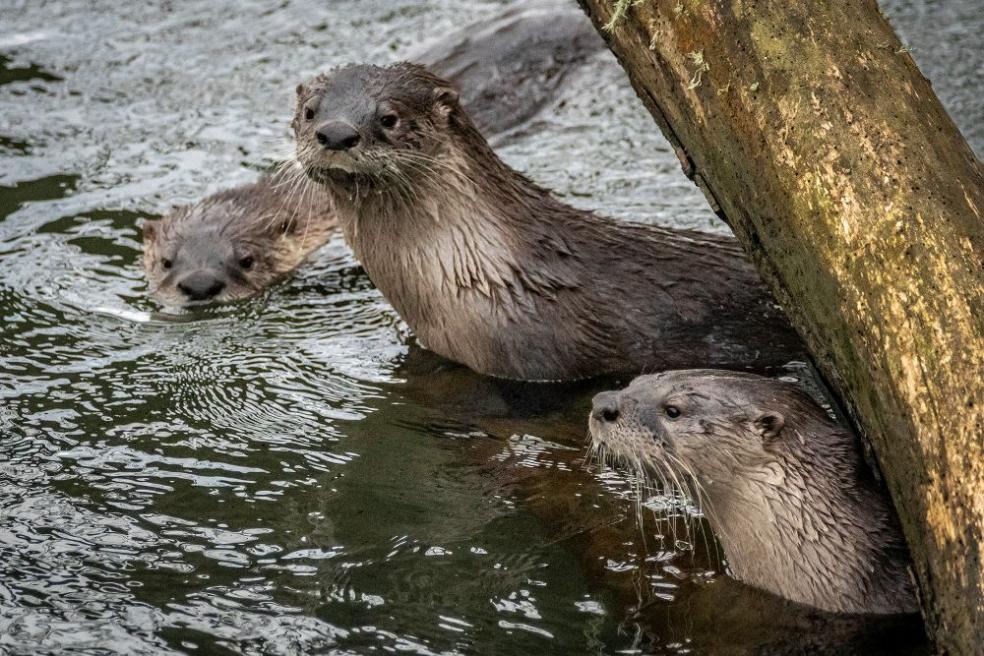
Now, marking the 27th and final year of this long-term research effort, Black is sharing new observations at the Arcata Marsh & Wildlife Sanctuary—a place where wastewater treatment, wildlife habitat, and public access intersect.
Based on two years of intensive study, the latest findings, published in the Northwestern Naturalist, reveal just how deeply river otters rely on the marsh. Otters were present nearly every day, using the wetlands not only to hunt, but to raise pups, socialize, rest, and navigate a landscape shared with hundreds of daily visitors.
“Watching the daily interactions between these top predators and their prey was a treat,” says Black. “These river otters regularly switched between fishing for fish and hunting for waterbirds—depending on which pond they entered.”
The findings challenge common assumptions about river otters. While often thought of as fish specialists, the study shows that waterbirds—ducks, coots, and grebes—make up a significant portion of their diet during much of the year. Otters were also observed using a wide range of hunting strategies, from repeated diving for fish to stealthy ambushes through dense vegetation.
At the Arcata Marsh, these behaviors play out in full view of the public. Otters regularly pause to watch people and dogs along nearby trails, sometimes continuing their activities, other times slipping quietly away. Despite the human presence, the marsh provides everything they need.
“In the past, people and river otters used the vast wetlands of California. Nowadays, thoughtfully designed or restored wetlands can still support all of us—people and wildlife,” Black says.
Beyond the research itself, the project has grown into a broader community effort. Black’s work has long been supported by local “otter spotters,” community members who help track sightings and share observations. That connection inspired the North Coast Otter Public Arts Initiative, a large-scale project that brought artist-designed otter sculptures to communities across the region.
The initiative did more than celebrate a beloved species. Proceeds from the sale of the sculptures funded graduate student research at Humboldt, supporting four projects focused on wildlife and conservation. Three of those students are now alumni applying their work in the field, with a fourth set to complete their degree this spring.
“I hope everyone who interacted with this initiative has learned more about art, nature, and science, and that our community rallied in celebration of artists, clean water, and wonderful otters,” Black says.
Together, the research and the art initiative reflect a shared investment in understanding and supporting the region’s ecosystems. The Arcata Marsh stands as a model of how infrastructure, habitat, and community engagement can come together—creating space not only for clean water and recreation, but for thriving wildlife.
Black’s latest publication and companion video (below) by Deborah Ketelsen, media production specialist for the Center for Teaching & Learning, offer a window into the world of river otters in the Arcata Marsh, inviting the community to see the marsh—and its otters—with a fresh perspective.
North Coast river otter spotters are encouraged to continue to submit their river otter observations to the larger, ongoing, community-based project celebrating river otters and clean water habitats, visit riverotterecology.org. Submit your wild river otter observations.