Coming to primetime: Your neighborhood Steller’s jays.
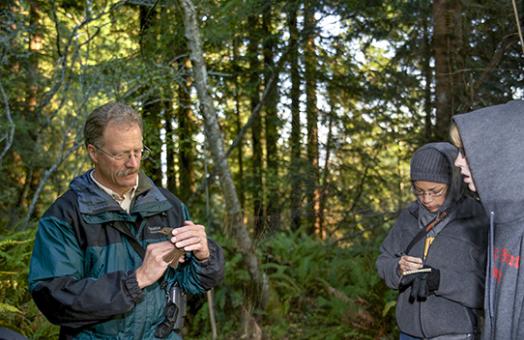
PBS' “Natural Born Hustlers” recently featured Steller’s jays from the HSU campus among other animals that rely on mimicry, disguise, and trickery to thrive in the wild. The pgoram is a three-part wildlife documentary in the station's long-running "Nature" series.
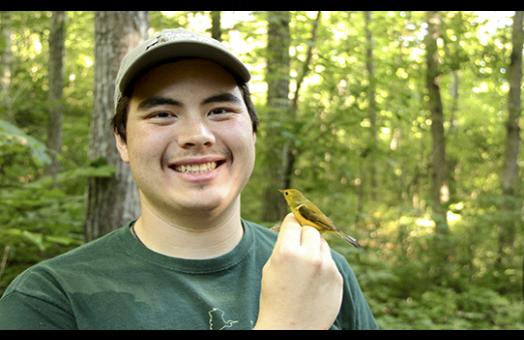
Growing up in Bangkok, Thailand, Gritidach Manakitivipart (Matee) wasn’t exposed to the opportunities beyond the urban environment and to life sciences at school. “That wasn’t really promoted as a career as much as it is in the U.S. Even so, I was still very interested in nature,” says Matee.
Today, he’s not just pursuing his love of nature as a Wildlife major at Humboldt State. He’s also being recognized for his research on a small, relatively unstudied songbird.
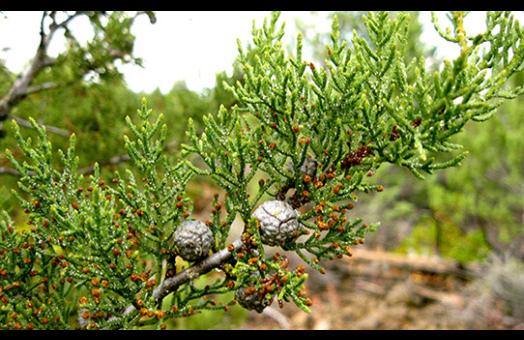
Four years of drought has turned much of California into tinder, and the resulting wildfires have torched vast swatches of forest. Fire suppression efforts have saved valuable commercial timberland, but another tree is being threatened by humans’ effort to control nature.
Over the course of the fall semester, Humboldt State NOW has been profiling our new tenure-track faculty. In this final edition, we introduce Professor Paola Rodríguez Hidalgo, Dept. of Physics & Astronomy, who lived most of her life in Madrid, Spain and specializes in Astrophysics.
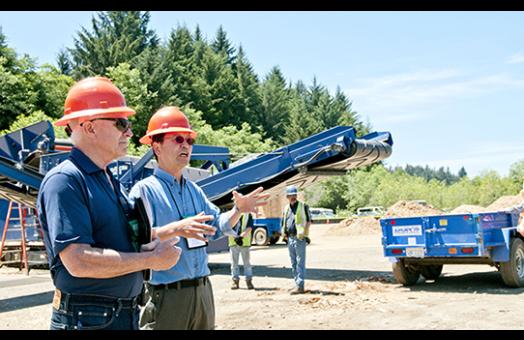
A potential revolution is unfolding on out-of-the-way logging roads. Foresters and researchers are innovating unique ways to make use of forest residues—low quality trees, tree tops, limbs, and chunks that formerly would have been left in slash piles and burned, or worse, left to rot.
The Humboldt State University Department of Mathematics welcomes Professor Federico Ardila from San Francisco State University and the University of the Andes in Colombia to deliver a lecture on the use of high-dimensional geometry to move robots efficiently from one position to another. The talk will also look at high-dimensional "spaces of possibilities". Mathematicians have studied these kinds of spaces and have developed "remote controls" to navigate them in their complexity. This talk will describe these techniques, and show their implementation. It will be accessible to a general audience, and assume no previous knowledge of the subject.
Over the course of the fall semester, Humboldt State NOW will be profiling our new tenure-track faculty. In this edition, we introduce Professor Melanie Michalak, Dept. of Geology, whose expertise is in tectonic geomorphology, landscape evolution and geochronology, and Professor Troy Lescher, Dept. of Theatre, Film, & Dance, who holds a Ph.D. in Interdisciplinary Fine Arts from Texas Tech University.
Fog is as much a part of Humboldt County as the redwoods. In fact, with their unusual ability to take in water through both roots and needles, redwoods directly benefit from the mist-laden air.
The Klamath River is a massive, breathtaking, and complex system with its own unique ecology and affected by political, economic, and cultural factors. It’s home to diverse communities including Native American tribes, farmers, and fishermen.
Humboldt State Environmental Resources Engineering students have teamed up with Zane Middle School students to explore ways to incorporate appropriate technology on the middle school’s campus. The projects will be on display during a reception on Monday, May 11, from 3:30 to 4:30 p.m. Zane Middle School is located at at 2155 S St., in Eureka.
Humboldt State is now accepting registrants for its Marine Science Summer Program for children, scheduled for July 20-24 and August 3-7 at the Telonicher Marine Lab in Trinidad.
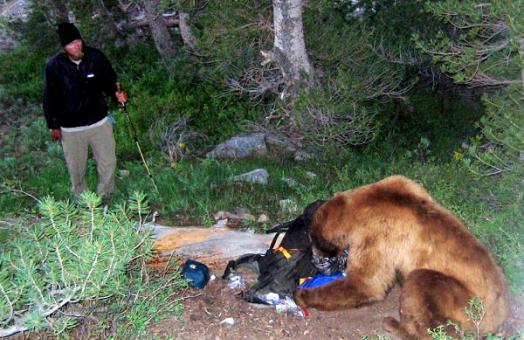
In the forests of Northern California, a mysterious animal lurks. Evidence of its existence is sparse and sightings are rare, but believers are convinced that it’s out there.
Humboldt State's Office of Research, Economic and Community Development (ORECD) has announced the results of the Humboldt State University Outstanding Student Research nomination and selection process.
Is the linear algebra being taught in schools even useful? Margot Gerritsen, an associate professor of Energy Resources Engineering at Stanford University, believes so.
It’s not uncommon for a young angler, enthralled by the flash of silver scales and blue water, to dream of going pro. This is certainly what Darren Ward had in mind when he enrolled as a fisheries science major, thinking it would simply be a good way to catch more fish.
Like a loving parent, Gayleen Smith instinctively knew when to push a young person a little harder. She realized when a gentle nudge in the right direction could make a big difference, and was glad to provide guidance, sometimes in the form of persistent reminders.
_Courtesy Deborah Seiler, Sea Grant California_
In contrast to the grey skies outside, marine scientist Christine Cass greets visitors to the Humboldt State University Marine Lab with warm smile. Perched on the rugged coast of Trinidad, Calif., the long halls of the laboratory offer glimpses of marine aquariums, ocean murals, and small classes in session.
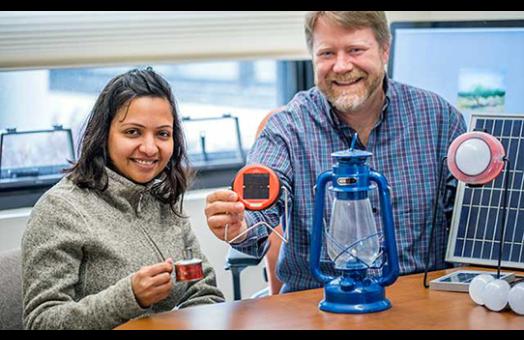
In the northern region of Pakistan is Chitral, a remote city that stretches across a green valley at the foot of the Hindu Kush mountains. There’s no Internet, electricity service can be spotty, and the closest major city, Peshawar, is a 14-hour bus ride away.
Who says engineering can't be fun? Students in Lonny Grafman's Engineering 215 let their creative juices flow as part of the annual Rube Goldberg design project.
Could desalination be the answer to California’s drought? As parts of the state become drier, scientists are looking at ways to turn seawater into drinkable water.
Analyzing statistics underscores the work many academics do, and being able to work comfortably with statistics can make the difference for a student. Professor Brian Dennis from the University of Idaho will discuss the roles of statistics in modern life as he delivers the 2015 Lamberson Ecology Lecture.