A groundbreaking microgrid developed to provide renewable power and energy resiliency for the Blue Lake Rancheria was put to the test during the recent statewide outage.
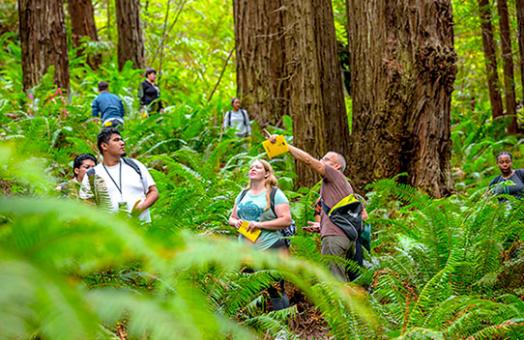
Humboldt State freshmen were welcomed into two new learning communities, Among Giants and Creando Raíces (Creating Roots), focusing on the unique biology of the North Coast, and strong foundations of identity and social justice.
Humboldt State faculty, staff, and student researchers were awarded a record-breaking $36 million in new grant funding—an increase of $13 million from the previous year—administered and secured by HSU’s Sponsored Programs Foundation (HSU SPF).
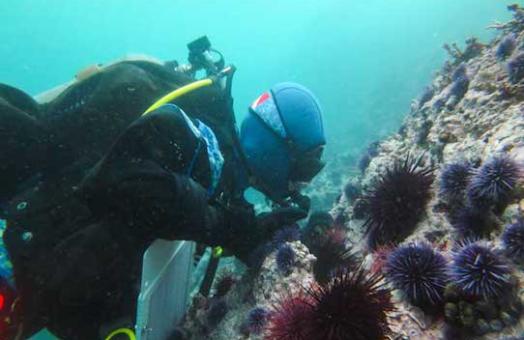
Researchers from Humboldt State University will continue studying marine life in protected areas on the North Coast, thanks to $9.5 million in total funding.
Reinforcing Humboldt State’s commitment to the community and environmental sustainability, HSU President Tom Jackson, Jr. joined K-12 teachers from across the state to tour a lumber mill in Scotia last Saturday.
A 2018 survey that counted more than half a million shorebirds on Humboldt Bay has led a conservation group to upgrade the bay’s status as a critical habitat for dozens of species of migrating and regional shorebirds.
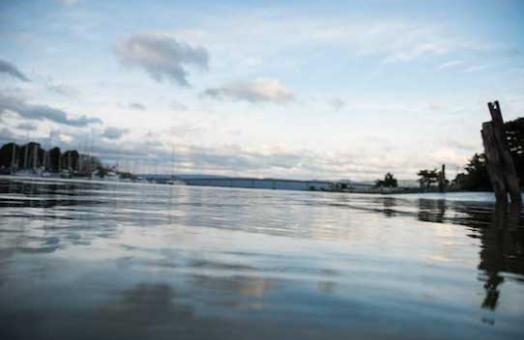
On April 11 and 12, the Humboldt Bay Symposium will be held at the Wharfinger Building in Eureka. This year’s symposium, “Rising to Meet the Challenges of Climate Change,” will feature sessions on sea-level rise, ecological restoration, ocean science, and proposed and ongoing economic development in and around Humboldt Bay.
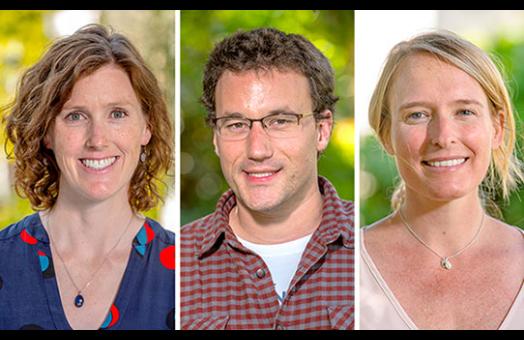
Environmental Science & Management Professor Kerry Byrne, Biology Professor John Steele, Forestry Professor Lucy Kerhoulas, and graduate student Christopher Ramponi won awards that recognize the accomplishments of HSU’s excellent newer faculty members and students.
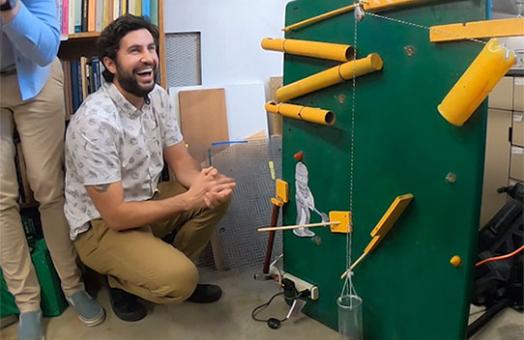
The goal seemed simple: Power down. How? In the most complicated way imaginable. That was the assignment for Engineering 215 students, who built crazy contraptions as part of the annual Rube Goldberg challenge.
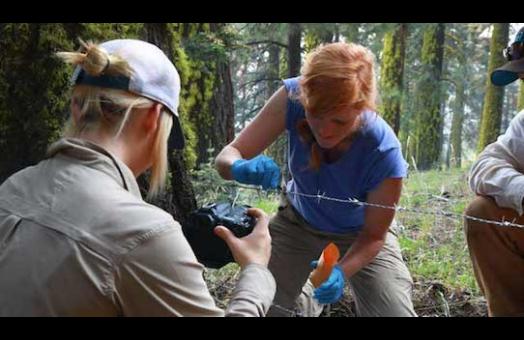
Wildlife biologists often espouse the importance of biological diversity, but what about diversity among wildlife biologists? HSU students and an alumna, plus a student from UC Davis, were determined to answer that question by creating a documentary film.
As the oyster capital of California, Humboldt Bay’s bivalve business is big for the region, with a local economic impact of about $20 million in 2016, according to a survey conducted by Humboldt State University and California Sea Grant researchers.
Humboldt State University is on the verge of receiving an 884-acre forest near campus, which will be used for research and field experiences. The effort is possible due to a generous donation from R.H. Emmerson & Son LLC, as well as major grants from state and federal agencies.
Humboldt State University has partnered with the University of Illinois to encourage and support students who study medicine to return to their rural communities and address the health care needs of Native Americans and their communities.
HSU’s Class of 2018 broke new records, with graduation rates for first-time and transfer students hitting all-time highs. The progress was thanks in part to several initiatives designed to support student success.
A new study shows Humboldt Bay to be one of the key sites in the western hemisphere for dozens of species of shorebird including western sandpiper, marbled godwit, and long-billed curlew.
Stephen Hillenburg ('84, Natural Resources Planning and Interpretation) is best known for making a lighthearted—and significant—contribution to the appreciation of marine life through the creation of the hit animated television series “SpongeBob SquarePants.”