Humboldt State is partnering with local volunteers and charities next week to ensure that students moving out of the residence halls have a minimal impact on the environment and the community.
Humboldt State University has donated a redwood tree that fell on the Campus Apartments to two local Native American tribes—the Bear River Band of the Rohnerville Rancheria and the Wiyot Tribe.
Humboldt State University has again been named among the 353 most environmentally responsible colleges according to The Princeton Review. The education services company features HSU in the 2015 edition of its book, The Princeton Review Guide to 353 Green Colleges.
The spring edition of HSU’s popular Sustainable Speaker Series continues through April with a variety of lectures on topics ranging from clean energy, environmentalism, to climate activism.
Electricity use accounts for nearly one quarter of the greenhouse gas emissions generated at Humboldt State, while transportation emissions from business travel, commuting, and solid waste disposal are responsible for over one third of the total. Those are two of the key findings from a comprehensive inventory of HSU’s greenhouse gas emissions, recently prepared by HSU’s Office of Sustainability.
Humboldt State University topped over 50 universities across the country in the 2014 Game Day Challenge, a national competition that encourages waste reduction at university and college football games.
Humboldt State University is moving aggressively to green up its endowment, taking a leadership role in higher education by further divesting from fossil fuels and adopting a broad definition of socially concerning sectors to be avoided. Significantly, the effort involves targeting mutual funds.
A solid waste research management proposal put forward by Humboldt State’s Environmental Resources Engineering program is one of three submissions selected for funding by the Environmental Research & Education Foundation (EREF).
As California copes with its fourth year of record low rainfall, Humboldt State is taking broad steps to reduce campus water use in its domestic and irrigation systems.
Think of Founders Hall as you might consider a classic car. Since it was first constructed in 1920, the venerable structure has undergone a variety of remodels, including paint jobs and bodywork. Still, its restoration to cherry condition remains incomplete.
Humboldt State students, staff and faculty took a sustainable ice bucket challenge at Trinidad Beach on Sept. 12, to raise awareness for amyotrophic lateral sclerosis (ALS).
In California a new story of environmental change is emerging. It is a story that tells how nature and civilization are no longer adversaries but partners, together creating healthy environments amid vibrant economies.
Humboldt State University and the Redwood Parks Association have received a $32,000 grant from the Bureau of Land Management and the Conservation Lands Foundation to promote stewardship of the Headwaters Forest Reserve.
This May the HSU Sustainability Office and the Waste Reduction & Resource Awareness Program (WRRAP) hosted Donation Dash, an annual event designed to reduce waste generated by students moving out of the residence halls.
Offering non-stop service from Alaska to New Zealand, the bar-tailed godwit’s journey is one of the more interesting stories to come out of scientists’ use of telemetry. Applications of the simple but effective tracking technique, however, benefit researchers in many less documented day-to-day projects.
Humboldt State University, along with 15 regional partners, has received a $5.88 million grant from the U.S. Department of Energy to conduct innovative biomass research.
Humboldt State University’s charitable foundation has adopted an expansive new policy to strictly limit its holdings in a variety of industries, including companies directly or indirectly involved in fossil fuels. And through its “Humboldt Investment Pledge” is urging other foundations to do more to clean up their investments.
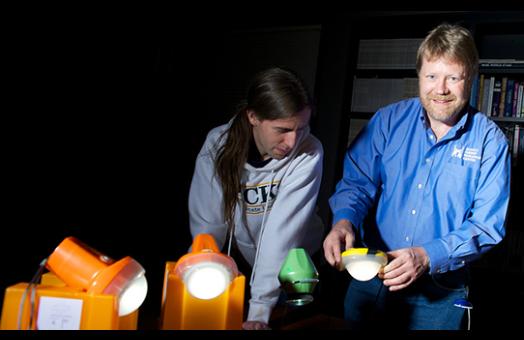
Humboldt State’s Schatz Energy Research Center has been awarded a pair of grants totaling more than $2 million from the World Bank Group to support its continued involvement in the Lighting Global initiative. Lighting Global and its sister programs, Lighting Africa and Lighting Asia, support the development of commercial markets for solar charged off-grid lighting products that are affordable to low income people in developing countries.